Wildfire smoke no longer stays where the fire is. Smoke from fires burning hundreds of miles away, in Canada, the Midwest, or further afield, has settled over Central New Jersey in recent summers, turning skies hazy and pushing outdoor air quality into unhealthy ranges for days at a time. What many homeowners don’t realize is that closing the windows isn’t enough to keep that smoke out of the air you’re actually breathing indoors.
Indoor air quality problems from wildfire smoke are a home performance issue as much as a weather event. Fine smoke particles find their way in through the same gaps and systems that let conditioned air in and out of your home every day. Here’s how that happens, what you can do during a smoke event, and what fixes actually hold up over time.
Why Wildfire Smoke Is an Indoor Air Quality Problem, Not Just an Outdoor One
Wildfire smoke carries fine particulate matter small enough to pass through standard window seals, door frames, and basic HVAC filters. Studies from public health agencies have consistently found that indoor particulate levels rise during smoke events even in homes with windows and doors closed, because the particles are simply too small for most homes to block passively.
This matters most for households with young children, older adults, or anyone managing a respiratory condition, since fine particulates are the fraction of smoke most associated with breathing discomfort. We are not a medical provider and can’t advise on individual health risk, but we can help reduce the amount of outdoor particulate matter that reaches your indoor air.
How Smoke Particles Get Into Your Home
Gaps Around Doors, Windows, and Ductwork
Most homes have small gaps around window frames, exterior doors, and duct connections that go unnoticed during normal weather. During a smoke event, those same gaps become entry points for particulate-laden air, pulled in by everyday pressure changes as doors open and appliances run.
Your HVAC System’s Fresh Air Intake
Many central air systems are designed to bring in a small amount of outside air for ventilation. That’s a good thing on a clear day, but during a smoke event it can actively draw smoke into your ductwork and circulate it through every room the system serves. Leaky or poorly sealed ductwork compounds the problem by drawing in additional unfiltered air as it moves through your attic, basement, or crawlspace.
Signs Smoke Is Affecting Your Indoor Air
A faint smoky smell indoors on a hazy day is the most obvious sign, but it’s not the only one. Watch for a visible haze near windows, increased dust buildup on surfaces, a dirtier-than-usual air filter after just a few days, or household members reporting eye or throat irritation that eases when they leave the house.
What You Can Do Right Now During a Smoke Event
Keep windows and doors closed and set your thermostat fan to run continuously rather than cycling on and off, since a running fan keeps air moving through your filter more consistently. Avoid using whole-house fans or opening windows for cross-ventilation on smoky days, since both pull outside air directly indoors. If your filter is due for a change, swap it before the smoke event rather than after.
Longer-Term Fixes That Keep Working After the Smoke Clears
Air Filtration Upgrades
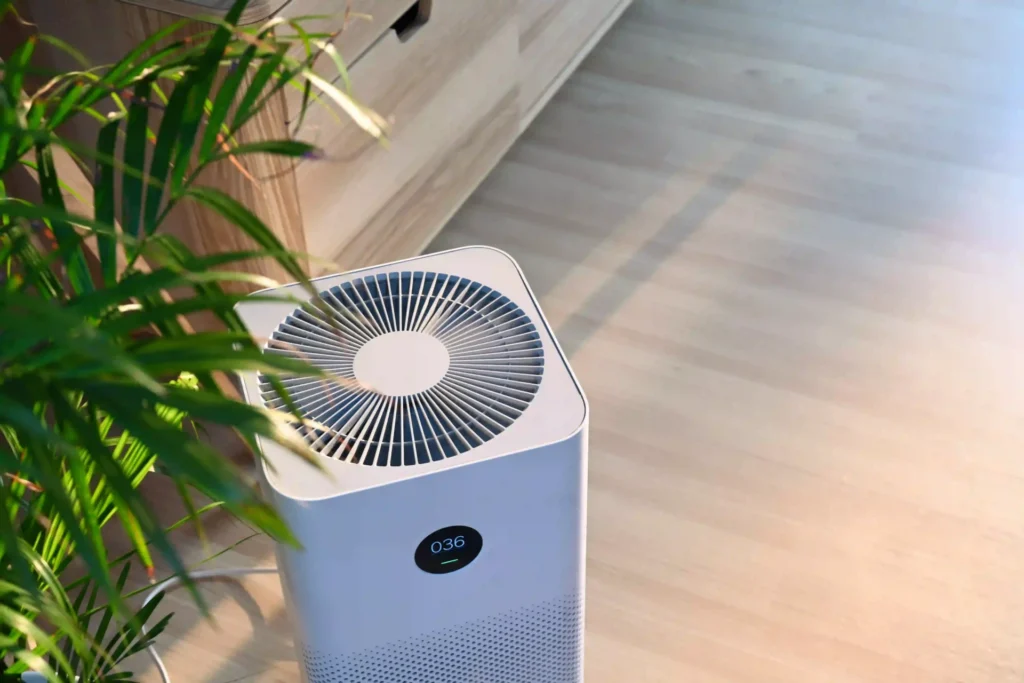
Standard fiberglass filters do very little against fine smoke particulate. A higher-rated air filtration system, sized correctly for your HVAC equipment, captures a far greater share of fine particles without restricting airflow the way an oversized filter can.
Whole-Home Air Cleaners
A filter alone can only do so much during a heavy smoke event. Whole-home air cleaners integrate directly with your ductwork to continuously scrub particulate from circulating air, rather than waiting for it to pass through a single filter location.
Duct Sealing
If your ductwork is drawing in unfiltered air through leaky joints or connections, no filter downstream can fully compensate. Duct sealing closes those gaps so the air moving through your home has actually passed through your filtration system, not around it.
IAQ Testing
If you’re not sure where your home stands, IAQ testing gives you an actual baseline reading rather than a guess, so any equipment recommendation is based on your home’s real conditions rather than a one-size-fits-all upsell.
Why This Matters More Than It Used to
Homeowners in our service area didn’t used to plan around wildfire smoke the way they plan around thunderstorms or winter cold. That’s changed in recent years, and it’s worth treating smoke season the way you’d treat any other recurring seasonal issue: with a plan in place before it happens, not a scramble once the haze rolls in. Upgrades like air cleaners often qualify for our current financing offer of 0% for 72 months on qualifying HVAC services, which makes tackling this ahead of the next event easier to plan for.
Frequently Asked Questions
Can my regular AC filter block wildfire smoke?
A standard filter blocks larger particles like dust and pet dander but is not designed to capture the fine particulate found in wildfire smoke. A higher-rated filtration upgrade is generally needed for meaningful improvement.
Should I run my AC during a smoke event?
Running your system with the fan set to continuous, rather than cycling with the thermostat, keeps air moving through your filter more consistently. Confirm your specific system settings with a technician if you’re unsure how to switch the fan mode.
Does a whole-home air cleaner replace the need for a good filter?
No. Air cleaners and filters work together. The filter protects your equipment and captures larger particles, while a whole-home air cleaner adds another layer for finer particulate.
How do I know if my ductwork is leaking?
Visible dust streaks near duct connections, uneven cooling between rooms, and higher-than-expected energy bills can all point to duct leaks. An inspection is the most reliable way to confirm it.
Is wildfire smoke exposure dangerous?
We’re not positioned to give medical guidance on individual health risk. Reducing indoor particulate exposure is a reasonable home improvement goal, and anyone with health concerns related to smoke exposure should consult a medical provider.
Schedule an Indoor Air Quality Evaluation
You can’t control when smoke drifts into Central New Jersey, but you can control how much of it ends up inside your home. Anthony’s Home Services has served Somerset, Princeton, Hightstown, and the surrounding communities since 1987, with NATE-certified technicians and a 4.6-star rating across 178 Google reviews.
Request a callback below to talk through filtration, air cleaner, and duct sealing options for your home, or call us directly at (908) 308-2635.